Is the book out?
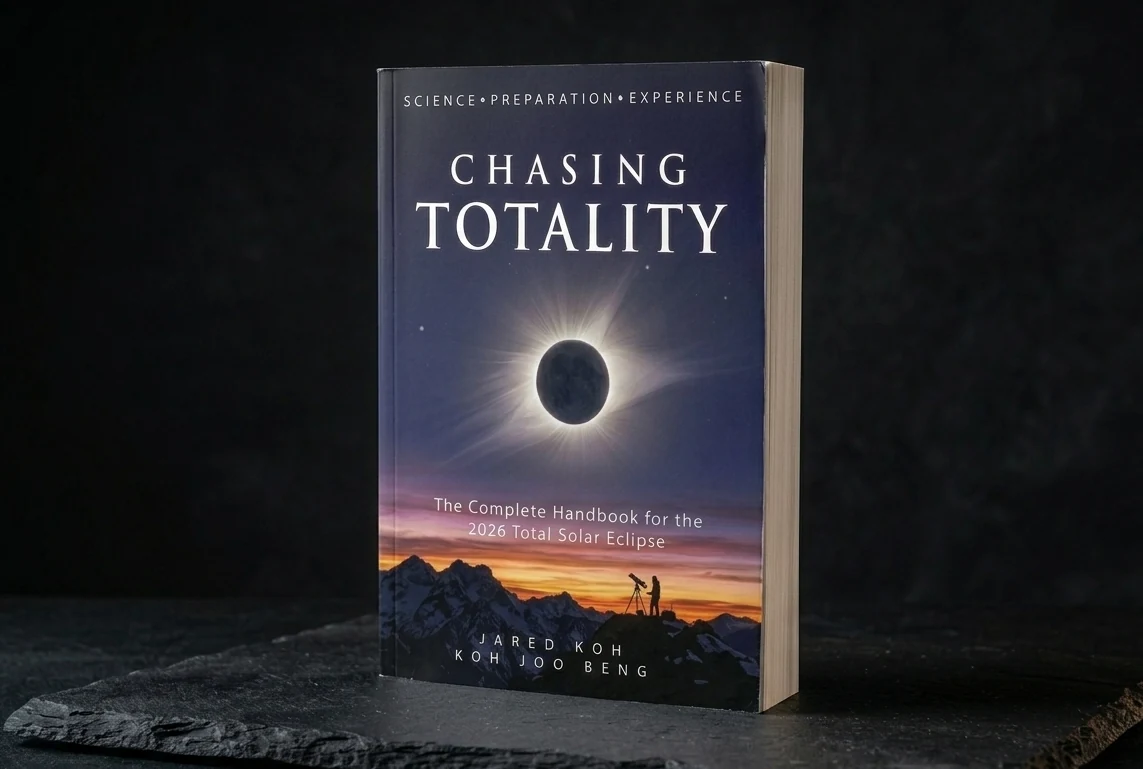
It is. All three editions — Kindle, softcover, and hardcover — published on 4 June 2026, roughly ten weeks before eclipse day on 12 August. Available on Amazon worldwide.
Why three editions — which one should I get?
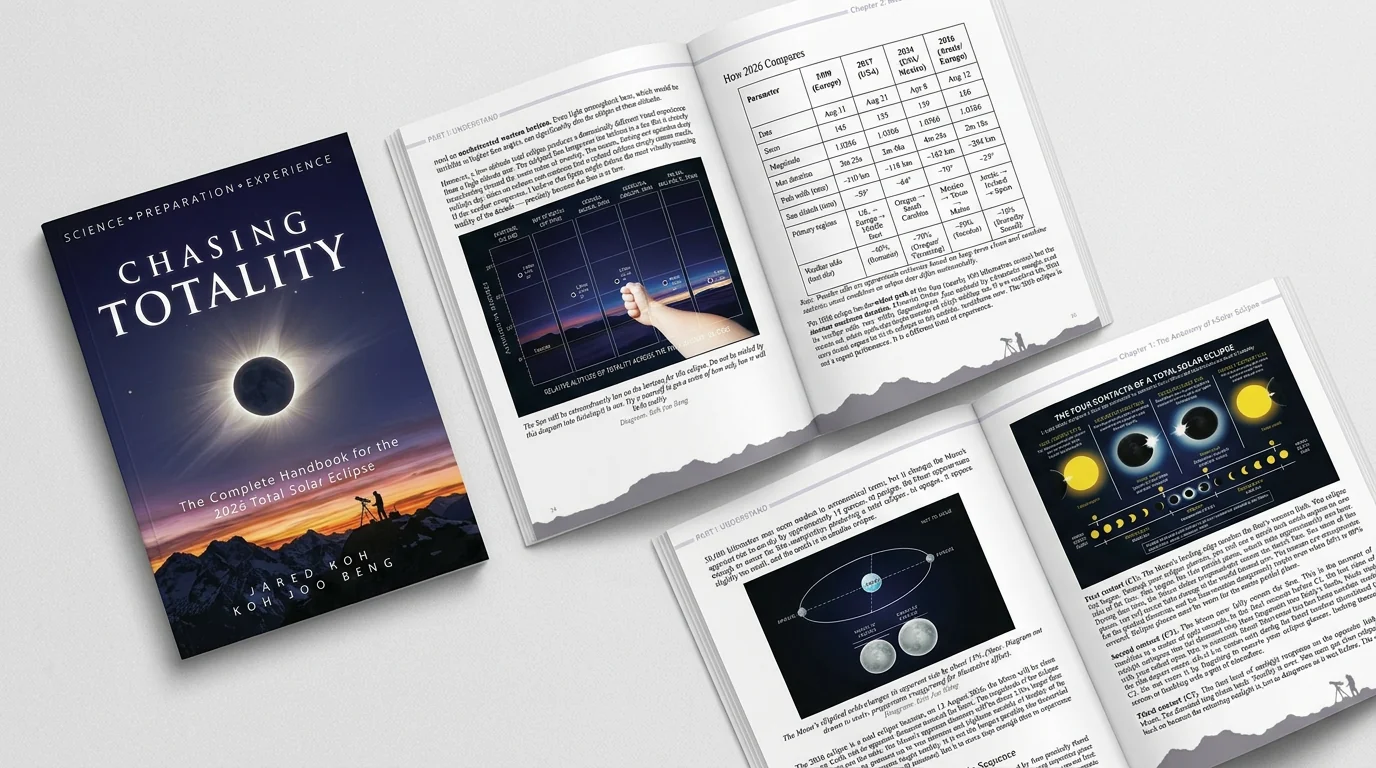
Three formats because eclipse chasers don't all want the same thing. The Kindle ebook ($9.99) is the easiest way in — full colour on compatible devices, searchable across all chapters. The softcover ($19.99) is the working copy — standard paper, priced to keep the book accessible. The hardcover ($44.99) is what we'd print every copy as if cost weren't a factor: premium paper, materially richer colour reproduction, and a hardback binding built to outlast the eclipse it documents. The content is identical in all three; the choice is about how you want to live with the book.
Does it cover my destination?
Chapter 4 is a full comparison of the three 2026 viewing regions — Iceland, northern Spain, and the Atlantic and Mediterranean eclipse cruises — with city-by-city contact times, how to read the cloud-cover odds, how to choose a site, and practical planning considerations for each. Those contact times are specific to 12 August 2026; the method behind them — reading cloud climatology, weighing mobility against comfort, choosing a site — is the same method you would apply to Egypt in 2027 or Australia in 2028. And on the perennial question: the book explains, honestly, why 99% is not 99% as good as 100%.
I've never seen a total eclipse. Is this the right book for me?
It's especially written for you. The whole book is structured around the idea that preparation is what unlocks presence — that you'll experience totality more fully if you know, in advance, what you're about to see. First-time observers are the primary audience.
I've seen totality before. Will I learn anything?
The science chapters go deeper than any pamphlet-style eclipse guide, and Koh Joo Beng's Veteran's Notes sidebars — drawn from two decades of chasing — offer practical insights you won't find in a first-timer guide. Experienced chasers tend to single out the shadow-bands section and the eclipse-day timeline, both of which apply to any total eclipse, not just 2026.
Is this a photography book?
Not primarily. It contains a photography cheat sheet and practical gear guidance for observers who want to record the eclipse, but the core message from both authors is: don't photograph your first totality. Use your eyes. The book exists to make that experience deeper, not to make you a better photographer.
What about eye safety?
Covered in detail, with ISO-certified filter guidance and clear protocols for when it is and isn't safe to look at the Sun. Eye safety is non-negotiable, and the book treats it that way.
I loved the book — how can I support it?
The single most helpful thing is a short, honest review. Leave one on Amazon if you're eligible, or on Goodreads — no purchase required there, anyone with a free account can post in a couple of minutes. For a small independent book, a few lines genuinely move the needle. Thank you.